










































Impact of ICTs-in-Agriculture on Rural Resilience in Developing Countries
Centre for Development Informatics, University of Manchester, UK
"To what extent is the use of ICTs-in-agriculture weakening or strengthening the resilience of rural households and communities in developing countries, and why?"
Agriculture has the potential to improve the livelihoods of rural populations in developing countries, but short-term shocks (e.g., conflict, economic crisis) and long-term trends (e.g., climate change) threaten to impede progress on rural development outcomes. Given their growing role in rural livelihoods, information and communication technologies (ICTs) such as mobile phones are regarded as central to rural resilience, though use of ICTs-in-agriculture (ICT4Ag) has also been associated with negative impacts such as inter-community conflicts and inequalities. These researchers undertook a systematic literature review (SLR) to establish: (i) the extent to which use of ICT4Ag is weakening or strengthening the resilience of rural households and communities in developing countries; and (ii) why the observed impacts are occurring. Overall, the paper is an effort to contribute new frameworks, new evidence, new practical guidance, and a research agenda for those seeking to strengthen rural resilience through use of ICTs.
The SLR was executed, and the results extracted, from June 6-15 2019 using Google Scholar. This led to a set of 45 ICT4Ag cases from Africa and Asia for analysis.
Resilience was measured using the RABIT (Resilience Assessment Benchmarking and Impact Toolkit) framework, which characterises resilient systems - at both household and community levels - by a series of sub-properties:
- Foundational attributes, including:
- Robustness - the ability of the system to maintain its characteristics and performance in the face of environmental shocks and fluctuations;
- Self-Organisation - the ability of the system to independently re-arrange its functions and processes in the face of an external disturbance, without being forced by external influences; and
- Learning - the capacity of the system to generate feedback with which to gain or create knowledge and strengthen skills and capacities (closely linked to the system's ability to experiment, discover and innovate).
- Enabling attributes, including:
- Redundancy - the extent to which system resources and institutions are substitutable (for example, in the event of disruption or degradation);
- Rapidity - the speed at which assets can be accessed or mobilised by system stakeholders to achieve goals in an efficient manner;
- Scale - the breadth of assets and structures a system can access to effectively overcome or bounce back from or adapt to the effects of disturbances;
- Diversity and flexibility - the ability of the system to undertake different courses of actions with the resources at its disposal, while enabling the system to innovate and utilise the opportunities that may arise from change; and
- Equality - the extent to which the system provides equal access to rights, resources, and opportunities to its members (seen as a key measure relating to successful long-term transformation of a system).
Section C lays out the findings of ICTs' impact on each of the RABIT framework resilience attributes. It is structured into 3 sub-sections: findings associated with ICT4Ag strengthening each resilience attribute; evidence of weakening; and a summary of the overall impact on household and community resilience attributes. Highlights include:
- At the household level, the evidence suggests that 3 attributes - household redundancy, diversity and flexibility, and learning - are strengthened most. Three attributes - household scale, rapidity. and robustness - are strengthened somewhat. Two attributes – household self-organisation and equality - are not evidenced as being strengthened very much.
- At the community level, the evidence suggests that the resilience impact of ICT4Ag is towards community self-organisation far more than any other attribute. Overall, except for equality, ICT4Ag interventions strengthen community resilience attributes more than weakening them.
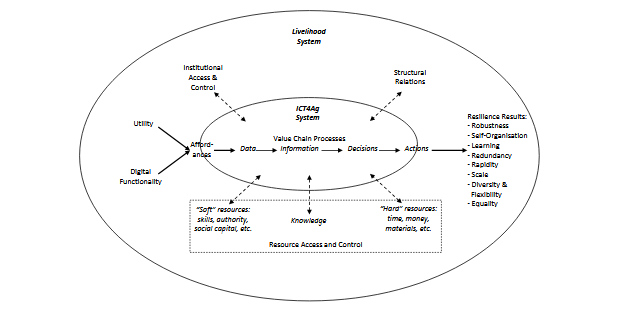
Section D provides further analysis and discussion of the findings, offering a new inductive conceptualisation to summarise why the observed resilience impacts are seen. For example, looking at the finding that ICT4Ag makes a relatively low contribution to self-organisation in the context of rural household resilience, the evidence suggests that ICTs' contribution towards maintaining the social networks, trust, or collaborative decision-making of household members occurs when those household members are in different geographical locations. But, for most rural households, face-to-face interactions are by far the dominant means of interaction and of self-organisation. Furthermore, ICTs' intra-household role is also limited because, at least until recently, ownership was typically limited to one device per household. On the other hand, at the community level, ICT4Ag makes a medium contribution to self-organisation. Some notable examples include mobile phone-based applications, such as M-Farm and Esoko, which have enabled the formation of contract-based linkages between groups of farmers and traders.
In short, reported evidence suggests ICTs are strengthening rural resilience far more than weakening it. However, the impact is uneven. Household resilience is built far more than community resilience, and there is a strong differential impact across different resilience attributes: equality in particular is reported as being undermined almost as much as enhanced. For example, 16% of sources provided evidence of ICTs weakening equality at community level - specifically, inclusiveness and participation - as men, the wealthy, and the educated tended to use ICTs and benefit more than their counterparts. Related data show that farmers who lack ownership and use of ICTs tend to be disconnected from the market; hence, further reducing their participation and bargaining position.
A new conceptual model is inductively created to explain some of these outcomes. It highlights the importance of individual user motivations, complementary resources required to make ICT4Ag systems support resilience, and the role of wider systemic factors such as institutions and structural relations.
Conclusions are drawn about the conceptualisation of resilience (in the RABIT framework). For instance, there is a need to better incorporate individual actors and agency: "all resilience-building assumes action for change. But that action will not happen unless individual actors are motivated for change, believe they can make a difference, and that change will be positive. Thus, these motivational and dispositional aspects of human agency are arguably a foundation for resilience without which no other elements can occur."
In sum, it is suggested that ICTs are building the resilience and adaptive capacities of rural households and communities in developing countries - in particular: through elimination of agricultural and market-related "information failures" that undermine learning; through linkages and network formation that not only reinforce or build social structure but also provide greater resource access; and by enabling a diversity of courses of action to support existing activities, among others. However, so far, the contribution has been small and incremental, one that is still insufficient to deliver the long-term resilience of rural households and communities in developing countries.
Finally, recommendations for policy, practice, and future research are offered. In brief, the researchers call for: focusing more equally on both household- and community-level resilience, attending more closely to the resilience-weakening potential of ICTs, ensuring perceived utility of digital applications among rural users, encouraging use of more complex ICT4Ag systems, and looking beyond the technology to make parallel, complementary changes in resource provision and development of rural institutions and social structures.
Email from Richard Heeks to The Communication Initiative on February 3 2020
- Log in to post comments